


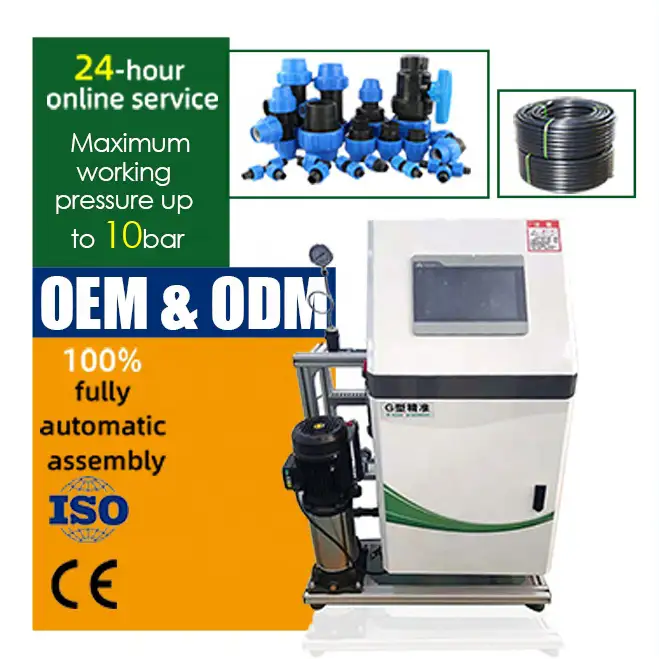
8-Channel Hydroponic Fertigation Controller - Drip EC/pH
Precise Compact Automated Control
This 8-channel hydroponic fertigation controller serves as a precision fertilizer applicator, stabilizing EC and pH with fuzzy PID control and offering EC-mixed or proportional water-and-fertilizer modes to cut waste and improve crop consistency. Its compact, modular housing, neat labeled packaging and modern professional style with mounting brackets and plug-and-play fittings make installation simple while supporting 32 solenoid valves (expandable to 64) and flexible decoder-based field control. Built from industrial-grade components and factory-tested for quality, it delivers real-time soil, meteorology, pressure and flow monitoring plus mobile app and background networking for scalable, low‑maintenance remote fertigation management.
Automated 8-Channel EC/pH Control
This 8-channel hydroponic fertigation controller serves as a precise fertilizer applicator, managing up to eight dosing channels (including one acid channel) with EC/pH monitoring and dual operation modes — EC-based fuzzy PID automatic control or proportional water/fertilizer flow control — while also supporting a non‑EC/pH monitoring mode. Its modular hardware and decoder expansion allow native control of 32 solenoid valves (expandable to 64), dual-bus field decoder flexibility, integration of additional dosing devices, and timed or cyclic irrigation scheduling with real-time soil, meteorological, pressure and flow data for optimized management. With background networking and mobile app control, the unit’s scalable structure and pipeline measurement capabilities deliver precise closed-loop fertigation for drip systems, reducing labor and improving fertilizer use efficiency.
Eight Channel Nutrient Control
This 8-channel hydroponic fertigation controller serves as a precise fertilizer applicator and drip EC/pH management system, supporting up to eight dosing channels plus one acid channel and allowing expansion of dosing devices. It provides EC hybrid fuzzy PID control to stabilize EC and pH, a water-and-fertilizer proportional dosing mode with flow measurement, or a non-EC/pH monitoring mode, and can manage up to 32 solenoid valves on-site (expandable to 64 via decoder) with flexible dual-bus field control. Additional features include timed or manual irrigation scheduling, real-time soil and environmental monitoring, and background networking with mobile app control for remote management.
◎
◎
◎
Precision Automated Nutrient Control
Born from years of commercial grower feedback and engineered by horticultural automation experts, the 8-Channel Hydroponic Fertigation Controller - Drip EC/pH pairs robust modular hardware with precision firmware for stable, scalable nutrient control. As a fertilizer applicator with eight independent dosing channels, integrated EC/pH sensing, automated calibration and precise scheduling, it delivers targeted nutrient dosing and continuous water quality adjustment for drip systems. Key advantages include high-accuracy probes, customizable dosing profiles, remote monitoring and alarm notifications, and fail-safe routines that reduce chemical waste, boost uniformity and simplify labor across small and commercial operations.
Material introduction
The controller's enclosure and mounting hardware are made from rugged, UV‑stabilized ABS/polycarbonate and optional powder‑coated aluminum, providing a corrosion‑resistant shell that protects sensitive electronics and solenoid valves in greenhouse or field environments. All wetted components — dosing pumps, fittings and tubing — use chemical‑resistant materials such as PTFE, HDPE or PVC and corrosion‑proof metals or reinforced engineering plastics, while EC and pH probes employ glass, PEEK and stainless‑steel construction to withstand nutrient solutions. These material choices deliver reliable, low‑maintenance operation for this 8‑channel fertilizer applicator and scalable fertigation controller, keeping dosing accuracy stable as the system expands to dozens of valves.
◎ Housing and structural materials
◎ Fluid paths and valve materials
◎ Sensors and electronics protection
FAQ